A book timeline is rarely a simple measure of effort. Learn why clarity, process, and a mapped method—not more hours—make focused drafting possible.
How long it takes to write a book is not a simple calendar question. The visible timeline can be six months, six days, or six focused hours of progress—but the difference is rarely a matter of effort alone. More often, it is a matter of process.
Most experts ask, “How long will it take me to write my book?” because the answer seems to determine whether the project belongs in real life. But that question can hide the more useful one: what must be clarified before drafting can move quickly and well?
The time trap is not a lack of ambition or a character flaw. A process problem often looks like a time problem until someone gives it a name and a path forward.
Start with a different question
Before asking how long a book will take, ask what work is actually included. Writing a manuscript is not one task. It includes deciding who the book is for, identifying the change the reader wants, organizing a method, choosing what belongs in the book, shaping examples and stories, and creating a sequence a reader can follow.
When those decisions are still being made during drafting, every page requires structural work. The project then feels slow because the author is trying to invent, organize, and write at the same time.
Six months was not a failure
A longer timeline does not automatically mean someone lacked discipline. It can reflect the real work of gathering years of expertise, identifying the most useful ideas, deciding which audience to serve first, and turning an intuitive way of working into a teachable method.
The difficulty begins when that work remains unnamed. An author may believe they are behind on writing when they are actually still resolving reader, method, structure, and scope decisions.
The timelines you are reading are incomplete
Published book timelines often describe only the period when a manuscript was visibly drafted. They do not always include the research, method design, content selection, audience definition, teaching practice, and revision decisions that made a faster draft possible.
That distinction matters. A fast draft is not necessarily a rushed book. It may be the result of doing the right preparatory work before the manuscript phase begins.
Faster without sacrificing quality
Speed does not come from removing thought, care, or reader value. It comes from moving the highest-leverage decisions earlier in the process.
When the reader is defined, the method is mapped, and the teaching has a clear arc, the writer is no longer asking every paragraph to answer foundational questions. Drafting becomes an act of assembling and refining a structure that already knows where it is going.
What the process actually is
The Author-to-Authority Roadmap treats the book as part of a larger body of work rather than as an isolated manuscript. It begins with the work that makes a book coherent, useful, and connected to the author’s next steps.
The early stages clarify the vision, success measures, buyer-ready reader, and method. The build stages turn that method into a signature book, companion titles, learning experiences, and an intentional offer structure. The launch stages make the work easier to discover, share, and improve.
About twenty-five AI-supported tools can help throughout that path, built on decades of professional writing and instructional-design practice. They can help an author clarify value and audience, map and outline a method, draft difficult pieces such as myths and teaching stories, turn existing classes and talks into chapters, and design activities that let readers apply what they learn.
The step called Manuscript Drafting has none of them. Every other step has tools. The step actually named for writing the book has none—and that is not an oversight.
By the time drafting begins, the reader is defined, the method is mapped, the teaching is structured, and the stories and reader activities already exist. Manuscript Drafting is where those pieces are woven into a cohesive experience that carries the reader along an arc of transformation.
You are not inventing at that point. You are assembling. That is the difference in speed.
Why the time belief holds on: blocks and gaps
A useful distinction sits underneath many book-writing frustrations.
Blocks are internal. They include limiting beliefs, unresolved issues, negative stories, counterproductive behaviors, and judgments—mental and emotional barriers that slow progress or stop it.
Gaps are external. They come from a lack of something: time, money, knowledge, skill, or support.
Both are secondary problems. Neither is always the critical problem underneath.
Lack of time is a gap, and it is the easiest kind of problem to name because it points outside the person. “I do not have time” is understandable and socially acceptable. But “I do not know how to organize what I know into a book” can be more useful because it has a solution.
The three pitfalls, in order
Three pitfalls often keep experts and authors stuck: lack of time, lack of clarity, and lack of confidence. The order is not a ranking. It is a diagnosis.
Lack of clarity produces lack of time because an unclear method forces structural decisions to be made while drafting, and that is what consumes the hours.
Lack of clarity also produces lack of confidence because it is difficult to judge a book whose shape cannot yet be seen. Gain clarity, and confidence can follow.
Time is listed first because it is what people report. Clarity is where the work actually is.
Sarah Lange: six months to six hours
Sarah Lange is a nonprofit fundraising expert whose method has raised millions for the organizations she serves. She wanted that method in the hands of struggling nonprofits.
She arrived with three problems that many experts recognize:
- Too busy — she was running her business.
- Too much content — she was trying to curate years of expertise.
- Too many audiences — she could genuinely help several groups and could not decide whom to serve first.
Once she worked out her Book Ecosystem, this is how she described the difference:
> “The last book I wrote took me about six months. This one so far has taken me six hours, and I have a bet with Licia that I could get this book done in under 72 hours.” > > — Sarah Lange, nonprofit fundraising expert
Same author. Same expertise. Same number of hours in her week. Six months, and then six hours. That is the wagon and the plane inside one person’s experience.
Where this work lives
The Author-to-Authority Roadmap organizes the work into nine steps across three phases.
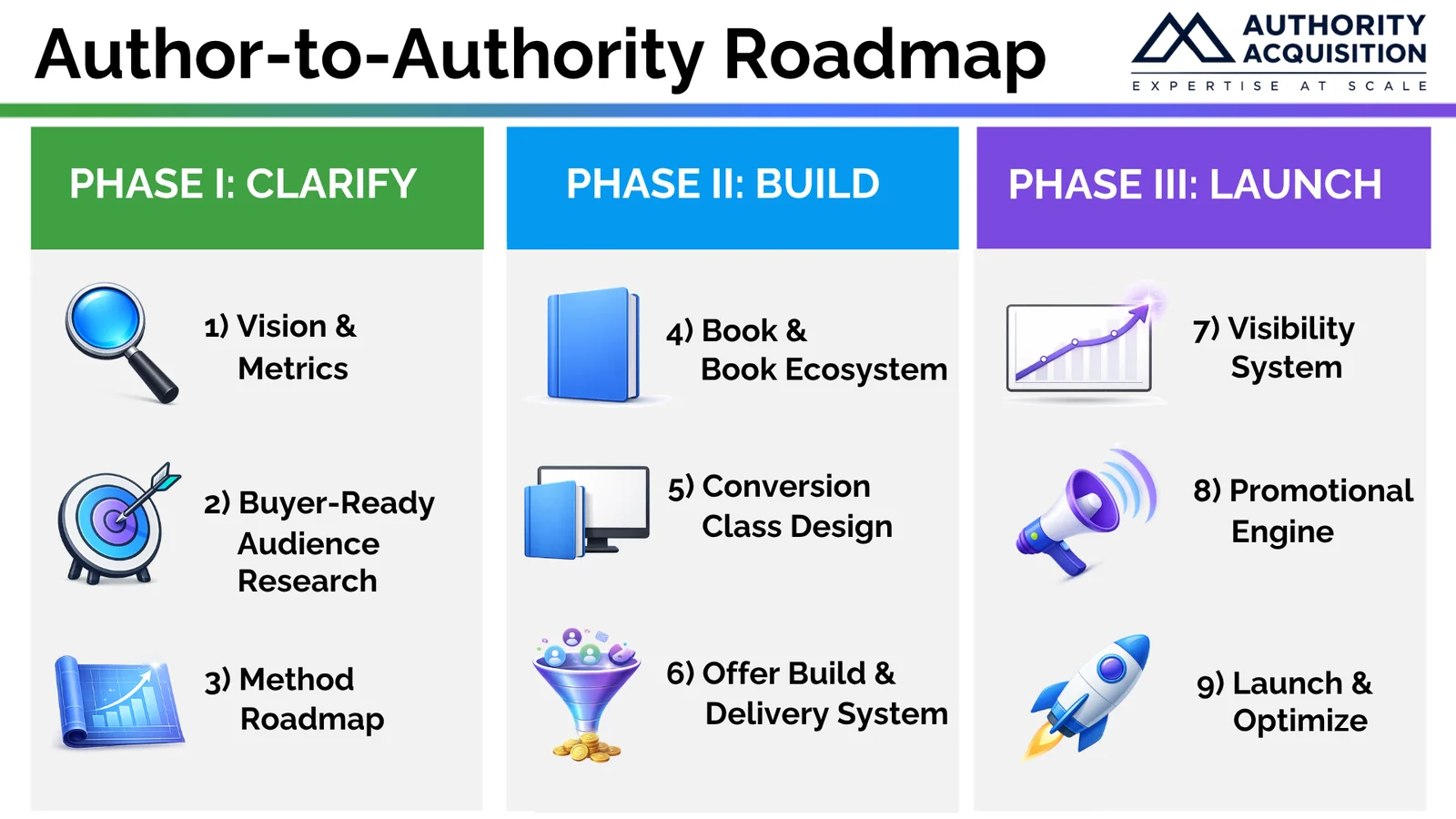
Method Roadmap is where an expert turns what they know into a teachable sequence—the reader’s bridge of transformation. Book & Book Ecosystem is where that sequence becomes a manuscript and where companion titles around a signature book are designed.
A Book Ecosystem is not a series. A signature book sits at the center like a sun, and companion titles orbit it, so any one can be a reader’s entry point.
Notice what comes first: vision and audience research. Those steps make a method mappable in the first place.
So what is the honest answer?
A couple of months is a useful average, not a promise. Most of that time is not drafting. It is learning and mapping the method—the work that makes drafting faster.
The timeline will move according to how much material is already organized, how clear the author is on the reader, and how much teaching already exists in talks, classes, client work, or other formats.
But the number was never the useful part. What sets the pace is the process being used.
Which vehicle are you in?
If a book has been waiting for a while, the honest question is not how many hours could be found if the project finally became urgent. It is whether the book is being planned with a process optimized for how books were written before the process itself was optimized.
Hours can be added to a wagon all day. It is still a wagon.
Your problem is not a lack of time. It is a lack of effective process. Unlike time, a process is something you can go and get.
Want the process?
The Author-to-Authority Roadmap shows how an expert can move from a body of knowledge to a finished book and the work that follows it.
See the Author-to-Authority Roadmap